Websites and local SEO for landscaping and lawn care companies.
Your season starts the week the weather turns, and the phone either rings or it does not. We build landscaper websites that are ready before spring: real job photos instead of stock, a page for every service and every town you work in, a quote form that captures the property details up front, and a Google Business Profile routine that keeps you in the map pack. We build the site and we do the SEO.
The site has to be ready before spring, not during it
Lawn care and landscaping demand is a curve, not a line. Searches for mowing, mulching, and spring cleanups start climbing in late February in most of Virginia, peak through April and May, dip in the heat, and spike again for fall leaf cleanups and aeration. A homeowner searching in March is choosing who mows their yard for the next eight months, and whichever companies show up in the map pack that week win the route.
That is why timing matters more for a landscaper's website than for almost any other trade. A new site and a new Google Business Profile take a few weeks to get crawled, indexed, and trusted. Launch in April and you are competing in the busiest month of the year with no history. Launch in December or January and by the time the first "lawn service near me" searches come in, the service pages are indexed, the profile has photos and a few reviews, and the town pages have had time to settle.
The same logic applies to the ongoing work. We add fall content in late summer, spring content in winter, and refresh the photo galleries at the end of each season so the site always shows the work homeowners are about to search for. The site is not a brochure you finish once; it is the thing that fills the schedule every year, and it should be maintained on the same calendar the business runs on.
Real job photos sell landscaping. Stock photos do not.
Landscaping is a visual trade. A homeowner deciding between three companies is not reading paragraphs about your commitment to quality; they are looking for a yard that resembles theirs and a result they would be happy to have. That means the single most valuable thing on a landscaper's website is a gallery of real work, shot on real properties in the area, ideally as before-and-after pairs.
Most landscaper sites fail here in one of two ways. Either they use stock photography of a manicured estate that no one in Virginia has ever mowed, which homeowners can spot instantly, or they have real photos but they are two years old, badly lit, and dumped into one page that takes fifteen seconds to load on a phone. We fix both. We help you set up a simple habit for the crew, a before shot on arrival and an after shot before leaving, and we build the galleries so every photo is compressed, labeled with the service and the town, and loads fast.
Those photos then do double duty. Each service page gets its own gallery of that kind of work, each town page gets photos of jobs in that area, and the same images feed the Google Business Profile, where fresh photos every month are one of the clearest signals that the business is active. See how we handle imagery and speed on our websites and web apps page.
Every landscaper site we build ships with
- ✓ Before-and-after galleries of real jobs, compressed and fast on a phone
- ✓ A page per service: mowing, mulching and beds, design and installation, cleanups, and more
- ✓ A page per town or county you actually route crews to
- ✓ A quote form that captures address, lot size, services, and one-time versus recurring
- ✓ Click-to-call at the top of every page
- ✓ LocalBusiness and FAQ structured data so Google can read what and where you serve
- ✓ Google Business Profile set up to match the site exactly
- ✓ Analytics that count calls and quote requests, not just visits
A page for every service and every town you serve
Nobody searches for "landscaper." They search for the thing they need: mulch installation, sod, drainage, retaining wall, leaf removal, weekly mowing. A homepage with twenty services in a bullet list ranks weakly for all twenty. So we give each real service its own page, with its own heading, a plain description of how you do the work, what a customer should expect, a gallery of that specific job type, and a quote form at the bottom. For a typical company that means a page for mowing and maintenance, one for mulching and bed care, one for landscape design and installation, one for spring and fall cleanups, and pages for whatever else you want more of, such as hardscaping, drainage, or sod.
Service-area pages do the other half of the job. Google shows results based on where the searcher is standing, so a company based in one town that routes crews to five others is competing in six different map packs. A page for each of those towns, with real photos of jobs there, the neighborhoods you already service, and the specifics of the lawns in that area, gives Google a reason to show you to someone searching from there. We skip the towns you do not want to drive to. The mechanics are on our local SEO in Virginia page.
Underneath both, the site is hand-coded and small so it loads fast on a phone in a driveway, with structured data that tells Google what you offer and where. That is the foundation the rest of the SEO work builds on.
A quote form built for recurring service
The best lawn care customer is the one you mow every week for years, so the quote form should be built around that. Instead of a generic "message us" box, ours asks for the property address, an idea of the lot size, the services they are interested in, and whether they want one-time work or recurring service. With the address you can look at the lot on a satellite view and often price a mowing route without driving out, and you can see at a glance whether it sits on an existing route or twenty minutes off it.
Every submission emails you instantly with the details laid out cleanly, and the customer gets a confirmation so they know a real person is going to follow up. A hidden field and a timing check keep bots out without making the customer solve a puzzle. If you want, quote requests can be logged to a spreadsheet or pushed into the scheduling software you already use, so nothing gets lost in an inbox during the spring rush.
For larger companies we build further: a customer portal for recurring clients, route planning, or a simple app that lets the crew record a job and take the after photo in one step. That falls under our custom software for small business work, and it is usually a second-season project once the site is producing leads.
What a lawn care quote form should ask
- ✓ Property address, so you can check the lot and the route before replying
- ✓ Approximate lot size, or a note that they are not sure
- ✓ Services wanted: mowing, mulching, cleanup, design, or something else
- ✓ One-time job or recurring service, and how often
- ✓ Name, phone, and email, plus one open box for details
- ✓ Optional photo upload for design and installation requests
- ✓ Invisible spam protection, so the form stays short
The Google Business Profile and reviews routine
For lawn care and landscaping, the map pack is where the calls come from, and the Google Business Profile is what puts you there. We claim the profile if it has never been claimed, then rebuild it from the top: the most specific primary category that fits, secondary categories for the services you want more of, a full service list, a service area that matches the town pages on the site exactly, hours that are right, and a description written in plain English rather than keywords.
Then the routine. Photos of real jobs added every month, because a profile with a fresh photo from last week looks like a business that is working and a profile whose last photo is from three seasons ago looks closed. A review request sent by text with a direct link when a job or a first month of service wraps up, and a reply to every review, good or bad, all inside Google's rules. Over one season that steady stream of recent reviews is what separates you from the companies that collected ten reviews years ago and stopped.
All of that is included in the Website + SEO Care Plan after launch: hosting, updates, security, the monthly profile and content work, and a short report each month that ties the work to calls and quote requests rather than to traffic numbers. You never have to log in to anything unless you want to.
One codebase, two lawn care brands
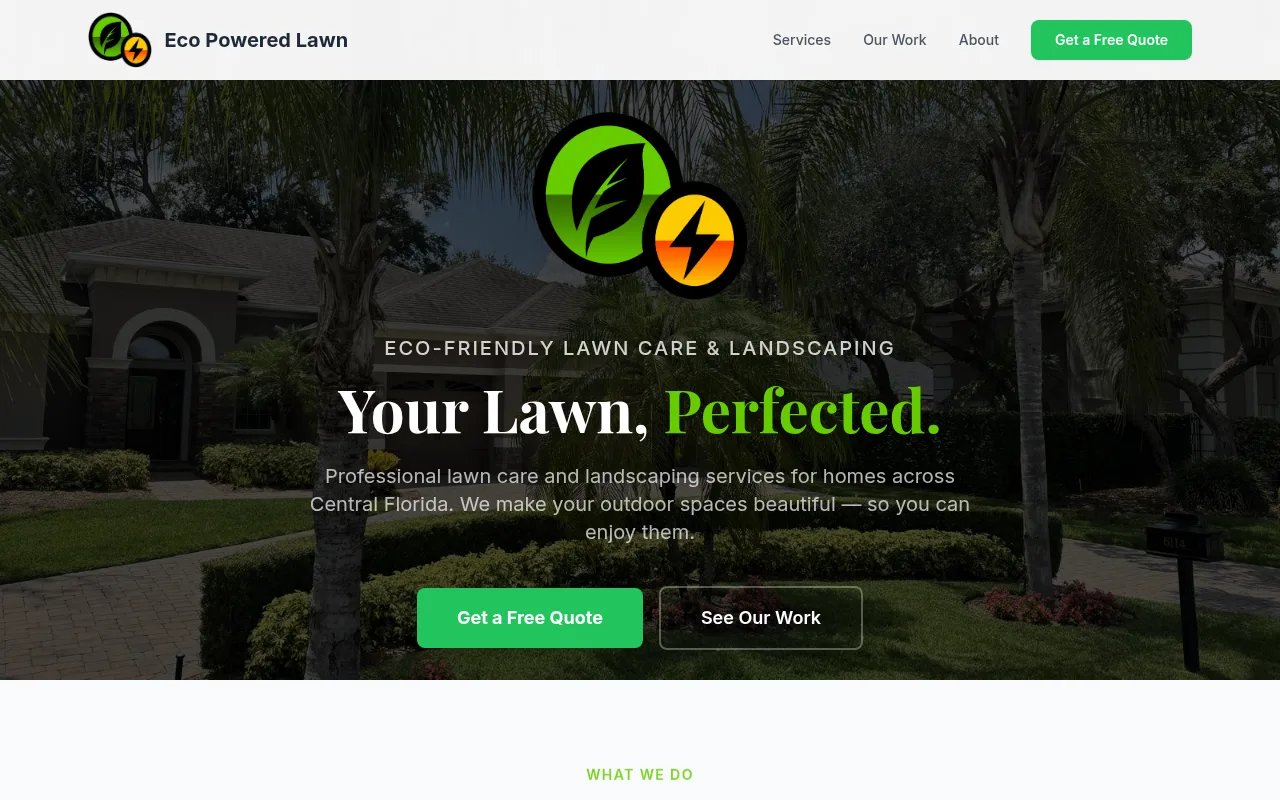
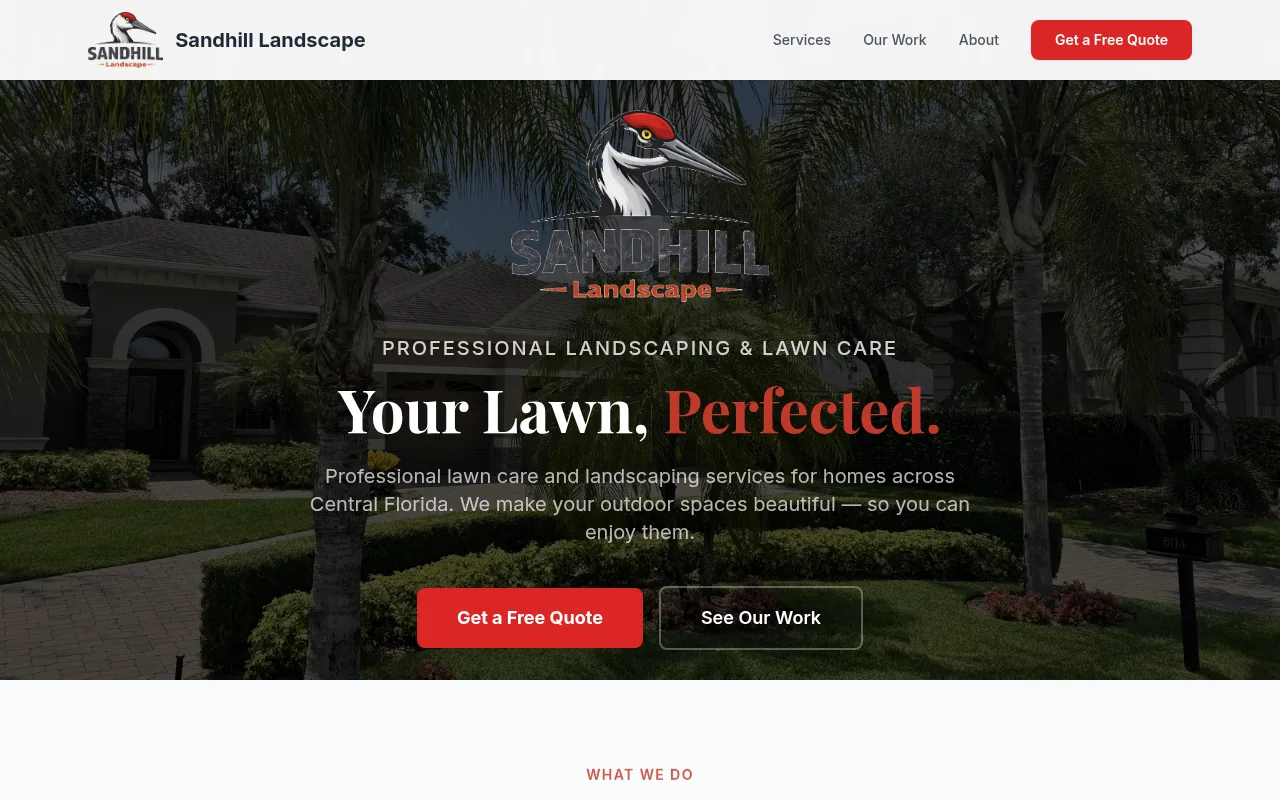
A Central Florida lawn care and landscaping company came to us with two brands: Eco Powered Lawn, an eco-friendly lawn care brand with a bright green identity, and Sandhill Landscape, a more traditional landscaping brand in red and charcoal. Same owner, same crews, same services, two different audiences. The obvious approach is two websites, which means two sets of pages to keep current, two galleries to update, and every service change made twice.
We built one site instead. The code detects which domain it has been loaded on and swaps the logo, the color palette, the tagline, and the brand-specific copy before the page renders, so a visitor to either domain sees a complete, distinct brand. The service pages, the photo galleries, and the quote form are shared, so a new before-and-after set or a new service goes live on both brands with one change. The site is built and awaiting launch, so there is no public link yet, but the approach is worth knowing about.
When a multi-brand site makes sense
It is the right call when one company genuinely sells to two audiences under two names: a lawn care brand and a landscaping brand, a residential name and a commercial name, or an established brand and a newer one aimed at a different part of the market. It is the wrong call when the two brands would have different services, different areas, or different owners, because then the shared pages become a compromise for both. If you are running two brands today with two sites, or thinking about launching a second, we can tell you quickly which way to go. More of our work is on the work page.
We build for other trades and local businesses too
Every trade has its own version of the one thing the website has to do. For a landscaper it is a quote request with the property details attached. See the full list on the industries page, or jump to a related one:
Contractors
Project galleries, service pages, and town pages for builders, remodelers, and site-work companies.
Plumbers
Fast, plain sites built to make the phone ring the day something breaks, with a page per service and per town.
Equipment dealers
Inventory pages Google can read, an admin portal for listings, and parts request forms that work in the field.
Landscaper website and SEO questions
Be ready before the season starts
The free audit shows how your company shows up right now from each town you serve, what your Google Business Profile is missing, how fast your site loads on a phone, and which service pages you do not have yet. You get a short written report whether or not you hire us. Or just call; we answer.