Inventory websites and SEO for equipment dealers.
A dealer's website has one job: put every machine on the lot in front of the buyer who is searching for it right now, with photos, specs, hours, and a way to ask about that exact unit. We build database-driven inventory sites with an admin portal you run yourself, then do the SEO that gets each listing found for the searches buyers actually type.
Your website is an inventory system before it is a brochure
Most dealer websites we audit are brochures. A home page, an about page, a phone number, and a single inventory page that is a PDF, a photo gallery, or a link out to a third-party marketplace. The buyer who searches for a used skid steer never lands on that page, because there is nothing on it for Google to match. The machine he wants is sitting on your lot, but on the web it does not exist.
The fix is structural. Every machine gets its own page with its own URL: make, model, year, hours, photos from all four sides and the cab, the spec sheet, attachments included, condition notes, and either a price or a price-on-request button that opens an inquiry form tied to that unit. When the machine sells, the page is marked sold and later redirected to its category so nothing goes dead. Categories such as skid steers, mini excavators, compact track loaders, attachments, and trailers become the hub pages Google ranks for the broader searches.
That is not a design choice, it is a data model, and it is the difference between a site that lists inventory and a site that is inventory. The way we approach that kind of build in general is on our websites and web apps page.
Every listing page carries
- ✓ Its own URL, title, and heading built from make, model, year, and category
- ✓ A photo gallery compressed on upload so it loads fast on a phone in the field
- ✓ Hours, serial, condition, attachments, and the spec sheet as structured data Google can read
- ✓ A price, or a price-on-request button, with an inquiry form that names the machine
- ✓ Similar machines and the category link so a buyer keeps browsing instead of leaving
- ✓ A sold status that keeps the page alive as a record and points buyers to what is in stock
An admin portal you run yourself, not a developer on call for every listing
The reason most dealer sites go stale is that updating them costs money or a phone call. A machine comes in on Tuesday and the listing goes up two weeks later, after someone emails the web company the photos and specs and waits. By the time it is online it may already be sold, and the buyers who searched that week found a competitor instead.
We build an admin portal into the site so the dealer, or whoever runs the front counter, adds a listing in about the time it takes to write the ticket. Log in on a phone or the shop computer, pick the category, fill in the make, model, year, hours, and price, upload photos straight from the phone camera, and publish. Edit the price when it changes. Mark it sold when it sells. Reorder the photos. Add a new category when you take on a new line. None of that touches us, and none of it is billed.
The portal is password-protected, separate from the public site, and simple on purpose: the fields you need, in the order you fill them in, and nothing you do not. If you also track machines in a spreadsheet, a dealer management system, or QuickBooks, we can connect the two so a unit is entered once. That is the same kind of work described on our custom software for small business page, applied to a dealership.
Ranking for "used skid steer for sale near me" one listing at a time
Buyers searching for equipment do not type your company name. They type the machine: "used skid steer for sale Lynchburg", "mini excavator dealer near me", "compact track loader for sale VA", "skid steer attachments Southside Virginia". Each of those is a different search that a different page ought to answer, and a brochure site has none of them.
A database-driven site produces those pages automatically. The category page targets "skid steers for sale" plus your area. Each listing targets its exact make and model. A page per brand you carry targets the brand plus "dealer" plus your area. A page for attachments and one for parts and service round it out. Because the pages are generated from the same inventory data they stay consistent: change a spec in one place and the title, heading, structured data, and sitemap update with it.
The local work still applies, and it matters more than most dealers expect. A Google Business Profile with the right primary category, your real lot address, and photos of machines on the yard instead of a logo. Service-area pages for the counties buyers drive from, because a buyer will drive two hours for the right machine at the right price. Product and offer structured data on every listing so Google understands each page is a machine for sale and can show it in the richer results it gives to inventory. The details of that work are on our SEO services page, and the starting point is the free website and SEO audit.
What we built for Luco Equipment
Luco Equipment is a dealer in skid loaders, mini excavators, and attachments. The site we built for them is not a set of pages; it is an inventory application with a public face. Machines live in a database. The owner signs into an admin portal, adds a machine, uploads photos from a phone, sets the category, and the listing is live with its own detail page, spec table, photo gallery, and an inquiry form that names that exact unit in the email the dealer receives.
The public side groups machines by category, so a buyer looking for a compact track loader sees compact track loaders and nothing else, then drills into the one he wants. When a unit sells, the owner marks it sold from the portal. There is no developer in the loop for any of that, and no monthly per-listing fee to anyone.
The site has not launched publicly yet, so there is no link to give you, but the build is described alongside our other projects on the work page.
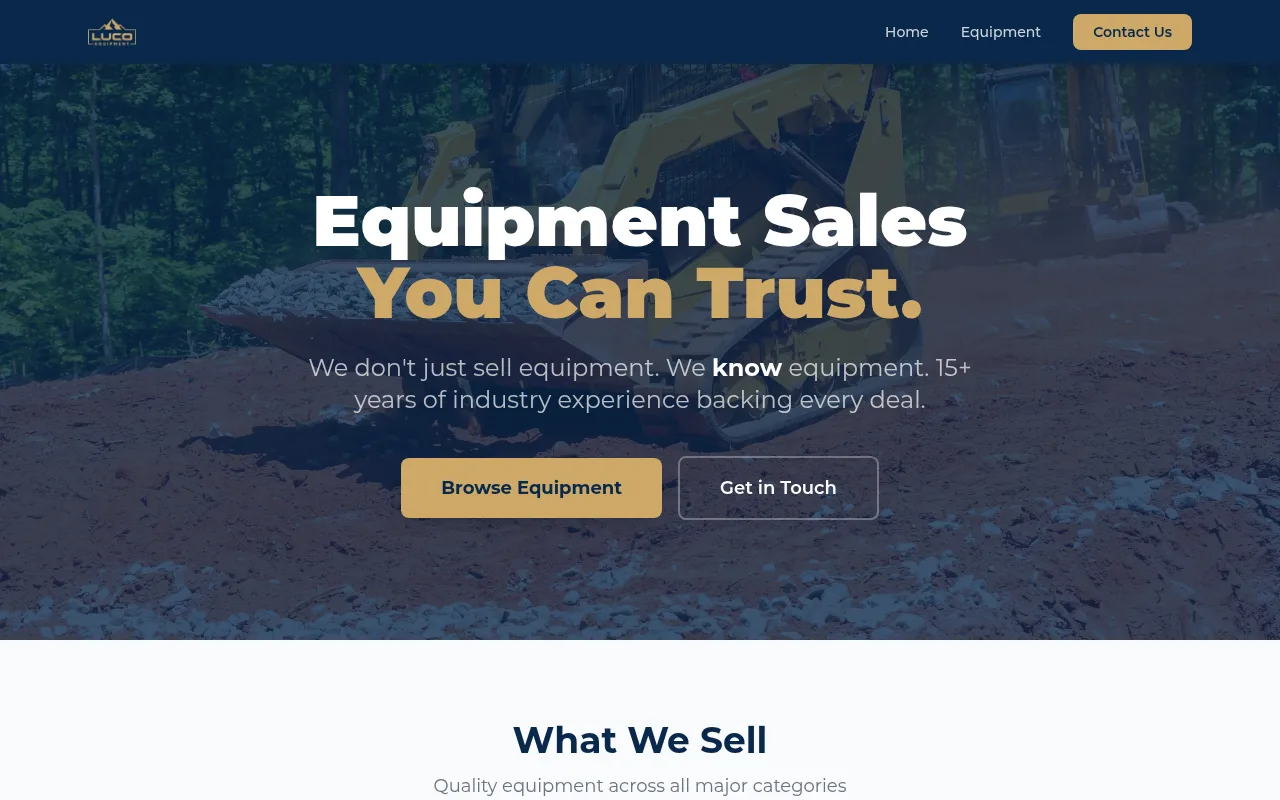
Luco Equipment
Database-driven inventory, a detail page per machine, an inquiry form on every listing, and an owner admin portal with photo uploads.
Why this is custom software and not a website template
There are equipment-dealer website templates and marketplace-hosted sites, and for some dealers they are fine. They also have the limits every rented platform has: your inventory lives in someone else's database, your listing pages look like every other dealer's on the platform, the monthly fee grows with your inventory, and if you leave, the pages and the rankings they earned leave with you. You cannot add a field, change how photos are handled, or connect it to the software you already run.
What we build is yours. The code, the database, the photos, the domain, and the rankings the listing pages earn all belong to the dealership. It runs on hosting we manage under the Website + SEO Care Plan, which covers hosting, updates, security, backups of the inventory database, the monthly SEO work, and a short report each month. If you later want financing applications, a rental calendar, a parts lookup, or a sync with your accounting, those are additions to a system built to take them, not a move to a new platform.
See how we weigh custom builds against rented software on the custom software page, and how the rest of our industry work fits together on the industries hub.
Other owner-operated businesses we build and rank for
Web design and SEO for contractors · Web design and SEO for landscapers · Web design and SEO for plumbers · All industries
Equipment dealer website questions
See what your inventory could rank for
The free audit looks at what your current site shows Google for the machines on your lot, who is ranking for the searches your buyers type, and what an inventory site with an admin portal would look like for your dealership. Or just call. We answer.