Websites and SEO for contractors and construction companies.
Whether the person searching is a homeowner with a driveway to replace or a utility's procurement manager looking for a line contractor, they open your site, decide in ten seconds whether you look capable, and move on. We build contractor sites that pass that check: projects, capabilities, safety, careers, and service pages that rank for the work you actually want.
Homeowners search. So do procurement people.
Contractors tend to fall into two camps, and the website has to know which one it is serving. A residential contractor, remodeler, paver, or excavator gets found the way a plumber does: a homeowner searches "concrete contractor near me" on a phone, looks at the map pack, checks reviews and photos, and calls. That is a local SEO problem, and the playbook is service pages, town pages, a strong Google Business Profile, and a phone number that is a button.
A commercial, industrial, or utility contractor gets found differently, and most agencies get this wrong. The person searching is a project manager at a utility, an estimator at a general contractor who needs a sub, a developer, or a procurement analyst filling out a prequalification list. They search "underground utility contractor Virginia" or "substation site work" from a desk, open four sites in tabs, and cut the ones that do not show capability, safety, and evidence of similar projects. Relationships and bid lists still win the work, but the site decides whether you get on the list. For that searcher, proof pages matter far more than a pretty homepage.
Many contractors are both. A site-work company might do commercial pads for developers and driveways for homeowners. We build one site that serves both audiences without confusing either, usually with a clear split in the navigation and separate service pages written for each kind of buyer. Our general approach to websites and web apps covers the build; this page is about what it looks like for construction.
Proof pages outrank brochure pages
The typical contractor site is a brochure: a hero photo, a paragraph about being family owned since a certain year, a list of services, a contact form. Google has nothing specific to rank, and a procurement manager has nothing specific to trust. The sites that get found and get called are built around proof.
Projects: real jobs with real photos, the scope in a sentence or two, the client type, the location, and the service lines involved. Each one is a page Google can match to a search and a buyer can forward to a colleague. Capabilities: one page per service line, phrased the way the buyer phrases it, with equipment, crew size, typical project size, and the regions you cover. Safety: your program, training, certifications, and whatever metrics you are proud of, because it is the first thing a utility's prequalification form asks for. Careers: real openings, an honest description of the work and the travel, and an application form that works on a phone.
These pages do double duty. They give Google specific content to rank for specific searches, and they give the human on the other end the evidence they were looking for. That is why they outrank brochure pages and out-convert them too. Our SEO services page covers how we plan and measure this content over time.
What a contractor site needs
- ✓ Services: one page per service line, written for the buyer who hires that line
- ✓ Areas: a page per state or region, plus localities if homeowners are part of the mix
- ✓ Projects: real photos, scope, client type, and location for each
- ✓ Safety: program, training, certifications, and the numbers prequal forms ask for
- ✓ Careers: current openings and an application form that reaches the right inbox
- ✓ Contact: a form routed to the right person, a phone number that is answered, and an address
- ✓ Speed and structure: compressed photos, compiled CSS, Organization and Service schema
A real contractor site, and a real speed rebuild
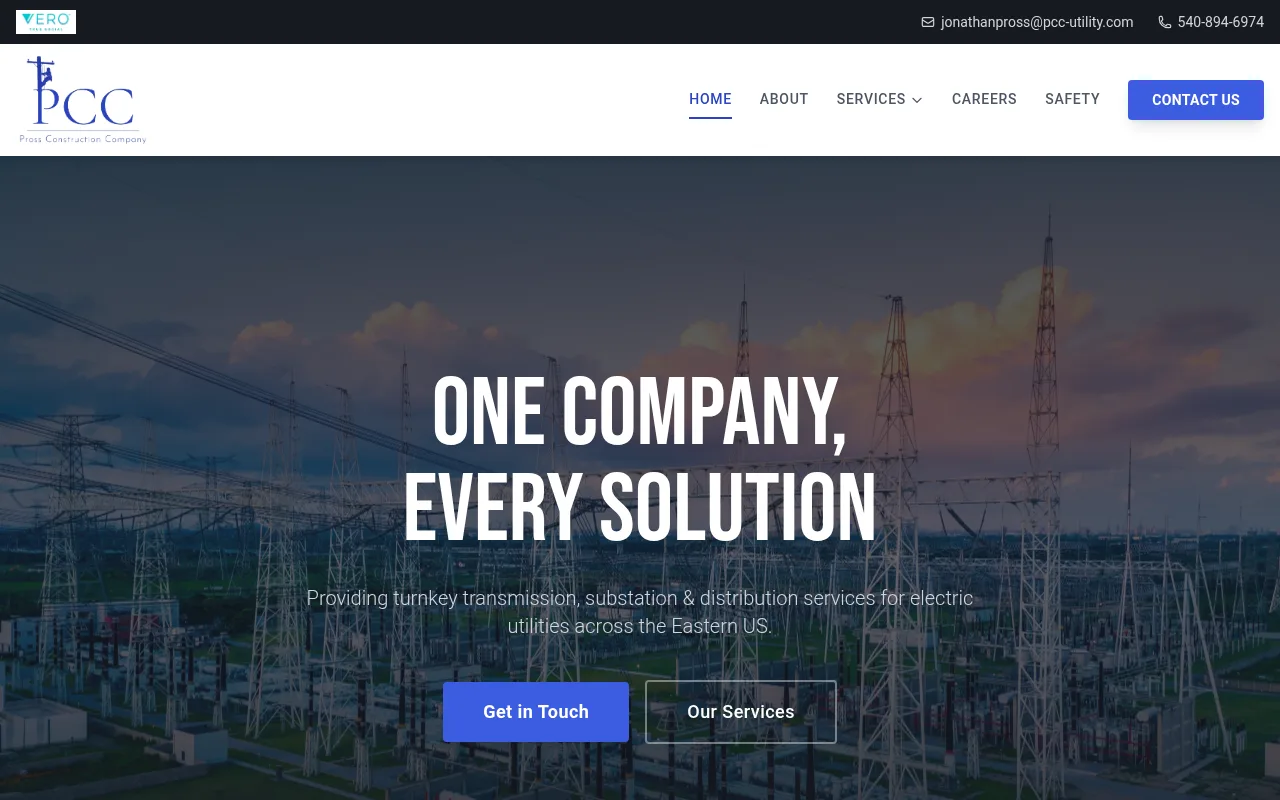
Pross Construction Company
Multi-state utility contractor · prossconstructioncompany.com
A 33-page company site for a utility contractor working across several states. Each service line has its own page, each Virginia location the crews work in has its own page, and the two are cross-linked so a search for a service in a place lands on something specific. Prospects reach the office through a contact form, and applicants apply through a careers form that lands in the right inbox, both with bot protection so nobody is sorting spam.
The site had also become slow. A speed rebuild took the mobile performance score from 43 to 95: images went from 55 MB to 5.5 MB with modern formats and proper sizing, the styling moved from a runtime library to compiled CSS, fonts were self-hosted, and the pages were rebuilt to load in the right order. Same content, same brand, a site that now loads on a phone at a job site.
- ✓ 33 pages: service pages and Virginia location pages, cross-linked
- ✓ Contact and careers forms with bot protection, routed to the right people
- ✓ Mobile performance score from 43 to 95 after the rebuild
- ✓ Images cut from 55 MB to 5.5 MB; compiled CSS; self-hosted fonts
- ✓ Sitemap and structured data so Google can read every page
Ranking for "line contractor," "substation," and "site work"
The searches that bring a utility or industrial contractor its best work are small and specific. "Overhead line contractor Virginia." "Substation site work." "Directional boring contractor." "Underground utility installation." Each of these might get a few dozen searches a month in a state, which is why most agencies ignore them. But nearly every one of those searches is a buyer with a project, and very few contractors have a page written for the term. That combination, low volume and almost no competition, is where niche B2B SEO pays off.
The method is simple and slow. We find the ten to twenty phrases your actual buyers use, which usually means asking your estimators what the RFQs say rather than trusting a keyword tool. We build one page per service line using that language, with equipment, crew, typical scope, and photos from real projects. We add a location page for each state or region you are licensed and working in, because "Virginia" and "North Carolina" are part of nearly every one of those searches. Then we back it with Organization and Service structured data and a projects section that keeps growing.
For contractors who also serve homeowners, the same site carries the local layer: a Google Business Profile in the right category, town pages for the places you actually drive to, and review handling. That side is covered in depth on our local SEO in Virginia page. Either way, the monthly work after launch runs through the Website + SEO Care Plan: new project pages as jobs finish, careers updates as crews grow, hosting and security, and a short report that ties the work to inquiries and applications rather than traffic.
A careers page that actually recruits
For most contractors, finding operators, linemen, laborers, and foremen is a harder problem than finding work. The website is a bigger part of that than it looks. Job boards get the first click, but almost every serious applicant then searches your company name and reads your site before deciding whether to apply. If the careers page is a one-line "we're hiring, call us," a lot of them do not.
A careers page that works lists the real openings, describes the work honestly (the travel, the hours, the per diem, the physical side), shows photos of actual crews rather than stock models in clean hard hats, and ends with an application form that takes two minutes on a phone. Applications land in the right inbox with bot protection, and the page picks up searches like "lineman jobs Virginia" or "equipment operator jobs near me" over time. We have built this for a utility contractor, and it is the page the office hears about most.
If hiring is a bottleneck, tell us. It changes how we structure the site, and it is where the careers form, the project photos, and the safety page start reinforcing each other.
Common contractor-website mistakes we fix
- ✓ A homepage and a contact page, and nothing a buyer can verify
- ✓ Forty full-size job photos in a gallery that takes fifteen seconds to load
- ✓ Services described in your words instead of the buyer's search terms
- ✓ No location pages for the states and regions you are licensed in
- ✓ A safety page that says "safety is our top priority" and nothing else
- ✓ A careers page with no openings, no form, and no photos of the crew
- ✓ A contact form that goes to a mailbox nobody checks
- ✓ Page-builder bloat that puts the mobile score in the 40s
Related industry pages
Plumbers and home-service trades
Tap-to-call sites, service and town pages, and the map pack routine for plumbing, HVAC, and electrical.
Equipment dealers
Database-driven inventory, a page per machine, and inquiry forms that reach the sales desk.
All industries
Landscapers, travel agencies, event businesses, and more. See every trade we have built for.
Contractor and construction website questions
See how your company looks to the person doing the hiring
The free audit times your site on a phone, checks which service, location, project, safety, and careers pages you have and which are missing, and shows who ranks for the searches your buyers actually type. Short written report, no obligation.