Websites and SEO for plumbers and home-service trades.
A plumber's website has one job: turn a person with a leak into a phone call before they scroll to the next name. We build fast sites with a page for every service and every town, wire them to your Google Business Profile, and do the monthly work that keeps you in the map pack. We have built for the trade, and we can show you.
A plumber's site is a phone-call machine, not a brochure
Nobody browses plumbing websites. The person visiting yours has a water heater leaking into the garage or a drain backing up on a Sunday, they searched on a phone, and they will tap the first result that looks real and answers. That changes every decision about the site. The phone number goes at the top of every page as a button, not as text in the footer. The first screen says what you do and where, in plain words, with a real photo of your truck or your work. The form is three fields, because nobody with a flooded kitchen fills out seven.
Behind that first screen, the site needs to be structured the way people search. Someone searching "tankless water heater install" and someone searching "sewer line repair" are different customers with different problems, and Google wants to send each of them to a page about exactly that. One long Services page listing everything you do rarely ranks for any of it. A dedicated page for each service, and a page for each town you drive to, is the whole difference between a site that exists and a site that rings. We build websites this way for every trade; the general approach is on our websites and web apps page, and this page is about what it looks like for plumbing, HVAC, and electrical work specifically.
The site and your Google Business Profile have to match exactly: the same business name, the same phone number, the same service list, the same towns. Google cross-checks them, and a mismatch is one of the most common reasons a well-reviewed plumber sits in fourth place behind a franchise with a worse reputation.
Every home-service site we build ships with
- ✓ Tap-to-call at the top of every page, visible before the page finishes loading
- ✓ A page per service and per town, each with its own title, heading, and real content
- ✓ Plumber, HVACBusiness, or Electrician structured data plus FAQ schema
- ✓ A three-field lead form that lands in your inbox with bot protection
- ✓ Compiled, hand-coded pages that load on one bar of rural signal
- ✓ Google Business Profile matched to the site line for line
- ✓ Call and form tracking, so the monthly report counts jobs and not visits
For trades, the map pack is the whole game
Search "plumber near me" or "AC repair" on a phone and the first thing you see is a map with three businesses under it. That block is the Google map pack, and for emergency home services it is where most of the calls come from. People tap the first name with a decent star rating and a call button. They rarely scroll to the regular results below it, and they almost never click to page two. If you are in the three, the phone rings. If you are fourth, you get the overflow on a busy day.
Four things decide who is in the three, and they are all workable. Your Google Business Profile: the right primary category (Plumber, not General Contractor), every service listed with a description, a service area that matches the towns you actually drive to, hours that are right, and photos of real jobs added every month. Reviews: the count, the recency, and whether you reply. Proximity: where your business address or service area sits relative to the searcher, which is why town pages matter. And the website behind the profile: Google reads it to confirm what you do and where, and a fast site with matching service and town pages is what separates a claimed profile from a ranking one.
We handle all four as one job, and the site work is what most plumbers have never had done properly. The mechanics of profile optimization, citations, and review handling are laid out on our local SEO in Virginia page, and the broader content and technical work is described under SEO services.
A real plumbing site, not a mockup
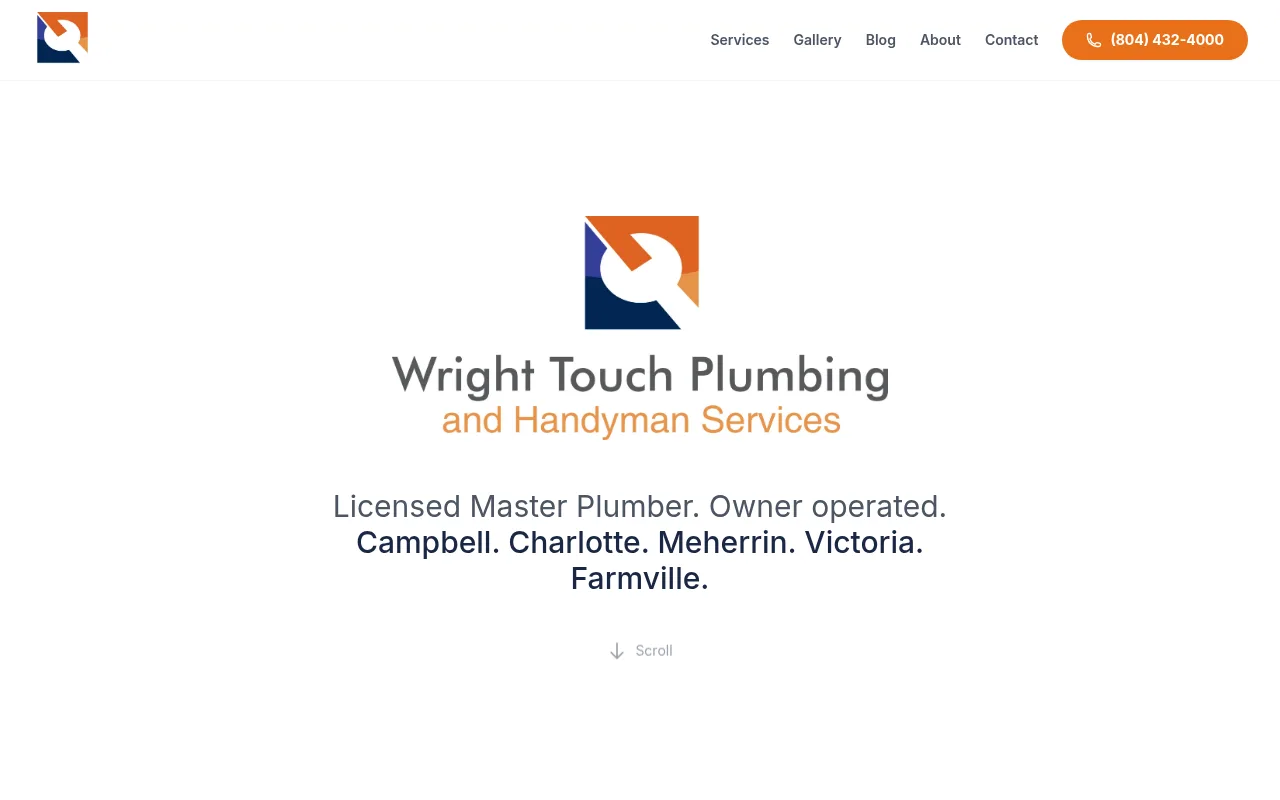
Wright Touch Plumbing & Handyman
Licensed Master Plumber, Southside Virginia · wrighttouchplumbing.com
An owner-operated plumbing and handyman business covering Charlotte, Campbell, Prince Edward, and Lunenburg counties. The homepage reads like a conversation with the owner rather than a template, because that is how his customers decide to trust him. Behind it is the structure that does the ranking: a services hub with eight dedicated service pages, a service-areas hub with six town pages, and Plumber structured data so Google knows exactly what kind of business it is looking at.
He did not want to call a developer every time he finished a job, so we built an owner admin portal where he publishes blog posts and gallery photos himself. Hitting publish regenerates the static pages and the sitemap, so the site stays fast and Google always sees the latest work. The whole thing is compiled and hand-tuned, and it scores 97 on mobile speed, which matters when the customer is on one bar of signal off a county road.
- ✓ Conversation-style homepage plus a services hub and 8 service pages
- ✓ Service-areas hub and 6 town pages across four counties
- ✓ Plumber schema, FAQ schema, and a sitemap that rebuilds itself
- ✓ Owner admin portal for blog posts and gallery photos
- ✓ Compiled site, 97 mobile performance score
Service pages plus town pages: the structure that ranks
The plumbing sites that win local search all share the same skeleton, whether the company is one van or ten. A homepage that says what you do and where. A services hub that links to one page per service. A service-areas hub that links to one page per town. That is it. The pages do not need to be long, but they need to be real, and they need to be about one thing each.
Service pages are organized around how customers search, not how you think about your trade. Water heater repair and replacement. Drain cleaning. Sewer line repair. Repiping. Well pump service, if you are rural. Bathroom and kitchen plumbing. Emergency plumbing. For HVAC it is AC repair, furnace repair, heat pump installation, ductless mini-splits, and maintenance plans. Each page explains what usually goes wrong, what the fix involves, what affects the cost without quoting a number, and which towns you do that work in, with a call button in the first screen and again at the bottom.
Town pages are how a plumber in one town shows up for a searcher standing in the next one. A real town page talks about the housing there, the age of the plumbing you tend to find, the water conditions, how long the drive is, and which services you most often do in that area. It links back to those service pages. A copied page with the town name swapped is ignored by Google and looks lazy to a customer. We write the real kind, for the four to eight towns that actually produce work, and skip the rest.
Underneath, every page carries the right structured data (Plumber, HVACBusiness, or Electrician, plus FAQ), a unique title and description, and internal links that make the hierarchy obvious to Google. A free website and SEO audit will show you which of these pages you have, which are missing, and which competitor already has them.
Reviews, the profile, and what a care plan does for a trade
Ranking in the map pack is not a launch event, it is a habit. The plumbers who hold the top three do a few small things every month: post job photos to the profile, answer every review, add or refresh a service, and keep hours and service areas current. The ones who slide out of it built a good profile once and never touched it again.
Reviews are the biggest lever you control. We set up a review link that opens straight to Google's form, a text template that sounds like you, and a moment to send it, usually while you are still in the driveway. Two or three new reviews a month, every month, passes most local competitors within a year. We also draft replies so nothing sits unanswered, including the one-star from the customer who wanted a free service call.
The Website + SEO Care Plan is how we keep this going for a trade business without you logging into anything. Hosting, security, and updates for the site; the monthly profile work; new town or service pages as the business grows; and a short monthly report that counts calls and form fills rather than pageviews. You text us the job photos and we do the rest.
Common plumber-website mistakes we fix
- ✓ Phone number as plain text in the footer instead of a button at the top
- ✓ One Services page listing everything, so nothing ranks for anything
- ✓ Stock photos of a smiling actor holding a wrench in a kitchen that is not in Virginia
- ✓ A template site with 4 MB of hero video that takes eight seconds on a phone
- ✓ Business name, phone, or service area that differs between the site and the profile
- ✓ A Google Business Profile in the wrong category, or claimed and never filled out
- ✓ Town pages that are the same paragraph with the town name swapped
- ✓ No way to tell whether the site produced a single call last month
Related industry pages
Contractors and construction companies
Proof pages, project galleries, careers forms, and SEO for both homeowners and procurement teams.
Landscapers and lawn care
Seasonal service pages, photo-heavy sites that stay fast, and town pages for a mowing route.
All industries
Equipment dealers, travel agencies, event businesses, and more. See every trade we have built for.
Plumber and home-service website questions
Find out why the other plumber is getting your calls
The free audit checks your Google Business Profile against your site, times your pages on a phone, lists the service and town pages you are missing, and names who is ahead of you in the map pack. You get a short written report whether or not you hire us.