Websites and booking for event and experience businesses.
Tastings, pairings, private classes, guided outings, pop-up dinners, corporate team events. If you sell an experience, your website has to do two things well: look like the experience is worth booking, and turn that interest into an inquiry with the details you need to say yes. We build the site, the booking form, and the search presence, and we handle the legal and age-verification pieces without hiding your pages from Google.
A booking inquiry with the right details in it
A plumber's website needs to make the phone ring. An experience business is different: the sale is a date on a calendar, and you cannot say yes until you know when, how many, where, and why. A contact form that only collects a name and a message produces a week of back-and-forth email before you find out the group is forty people on a Saturday you are already booked. That is a lost evening for you and a frustrated guest who has probably moved on to someone else.
So every page we build for an event business points at one action, and that action is a form that asks for the event date, the group size, the location or venue, and the occasion. Not twelve fields, just the four you need plus a way to reach the person. The inquiry lands in your inbox in seconds, formatted so you can read it on your phone between events, and the guest gets a confirmation so they know a human is going to respond. That single change is usually the biggest improvement we make.
Everything else on the site, from the photography to the way the experiences are described, exists to get the visitor to that form with their card in mind. You can see the general way we approach websites and web apps, but for an experience business the booking flow is the product.
What a good private event booking form captures
- ✓ Preferred event date, with room for a backup date
- ✓ Group size, so you can check capacity before replying
- ✓ Location or venue, or whether they need you to suggest one
- ✓ The occasion: birthday, corporate, client appreciation, celebration
- ✓ Which experience or package they are interested in
- ✓ Any legal confirmation your business requires, such as a 21+ checkbox
- ✓ Name, email, phone, and one open box for anything else
- ✓ Invisible spam protection, so the form stays short and your inbox stays clean
The look has to sell the experience
We tell contractors that a clean, fast, plain site with real photos beats a fancy one every time, and for a trade that is true. For an experience business it is only half true. Nobody books a private tasting, a chef's table, or a guided evening because the site was tidy. They book because the site made them feel what the evening would be like. Brand matters more here than in almost any other local business, and it shows up in details: the pace of the page, the size and quality of the photographs, the typeface, the amount of white space, the way an experience is described in a sentence instead of a bullet list.
That is why we do not start an experience site from a template. We start from the feeling you are selling. A whiskey and cigar evening wants dark surfaces, warm copper, and a serif that feels like a menu at a good restaurant. A family farm experience wants daylight, big sky, and a rounded, friendly face. A corporate team-building outfit wants something crisp that a human resources manager can forward to their boss without embarrassment. Getting this wrong does not just look off; it undercuts the price you are asking.
The other half of the job is doing all of that without a slow site. Big imagery and slow pages usually travel together, and a page that takes ten seconds to appear on a phone is a poor first impression for a premium brand. We hand-code the site, compress every image to a modern format, load fonts locally, and keep animation to a handful of deliberate moments. Rich on a phone, fast on a bad connection. Examples of that balance are on our work page.
Forms that reach you instantly and reassure the guest
The form is where most experience websites quietly fail. Either it is a generic contact widget that asks nothing useful, or it is a third-party booking tool bolted onto the page that looks nothing like the brand, adds a monthly fee, and occasionally just stops sending notifications. We build the form ourselves and wire it to a small backend we run, so it works the way your business does.
When someone submits, you get an email within seconds with every field laid out clearly, and the guest gets a short confirmation with what happens next and how to reach you if they are in a hurry. Behind the scenes the form rejects bot submissions with a hidden field and a timing check, so you are not sorting real inquiries out of spam. If you want inquiries logged to a spreadsheet, pushed into your calendar, or tagged by occasion so corporate requests get a different reply, that is a straightforward addition.
For businesses that sell fixed-time public events with set capacity, we can go further: live availability, deposits, ticketing, and automatic reminders. Most private-event businesses do not need that on day one, because nearly every booking starts with a conversation. We will tell you honestly which one fits, and the inquiry form can grow into full booking later without rebuilding the site.
What happens after someone hits submit
- 01 Spam and bot checks run silently; real inquiries pass through
- 02 You receive an email with date, group size, location, occasion, and contact details
- 03 The guest sees a thank-you page and receives a confirmation with what happens next
- 04 Optional: the inquiry is logged to a sheet, calendar, or CRM you already use
- 05 Analytics record the submission as a conversion, so you can see which pages produce bookings
Legal lines and age gates that do not block Google
A surprising number of experience businesses touch something regulated: alcohol, tobacco, firearms, a venue with its own rules, an activity that needs a waiver. That usually means two things on the website. First, a specific line of legal language that has to appear where a customer will see it, often on every page. Second, some form of age verification before the visitor sees the content at all.
The common way to handle the age gate is a plugin that throws a popup over the entire site and blocks everything until the visitor clicks through. Search engines do not click through. A gate built that way can leave Google seeing a blank page with a button on it, which means the site never ranks for anything, and the owner never finds out why. We have seen it more than once.
We build the gate differently. The page content is fully present in the HTML so a crawler reads it normally. The gate itself recognizes search engine and audit crawlers and steps aside for them, while every human visitor sees the verification screen. A verified visitor is remembered for a set number of days so regulars are not asked every time. If a business later needs strict date-of-birth capture, for example to sell products online, the same gate switches to that mode without a rebuild. The required legal line lives in the page template, so it cannot be forgotten on a new page.
We are not lawyers, and we will ask you for the exact language your attorney or licensing body requires. What we take responsibility for is making sure it is on every page, is readable on a phone, and does not cost you your search rankings.
Ranking for private-event and corporate-event searches
Experience businesses live on two kinds of search. The first is a person planning something: "private whiskey tasting Richmond," "bachelor party ideas Charlottesville," "birthday experience near me." The second is someone at a company with a budget and a deadline: "corporate event ideas Virginia," "team building experience Lynchburg," "client appreciation event." These are different people with different questions, and one homepage cannot answer both.
So we build a page for each. A private-events page that talks about occasions, group sizes, and how the evening runs. A corporate page that talks about logistics, invoicing, capacity, and what a planner needs to justify the choice to their manager. Where the business travels to the guest, a page for each city or region it serves, because Google matches "private event" queries to location, and a Central Virginia business without a Richmond page is invisible to someone searching from Richmond. The mechanics of that are covered on our local SEO in Virginia page.
Underneath the pages, the usual foundations: a Google Business Profile with the right category and real event photos, review requests sent after each event, structured data so Google understands what you offer and where, and a site fast enough to hold a mobile visitor. That is the same SEO work we do for every client, aimed at the searches that actually produce bookings. After launch, the Website + SEO Care Plan keeps the site hosted, updated, and working on those searches each month.
Smoke & Cask: a brand site with a compliant booking flow
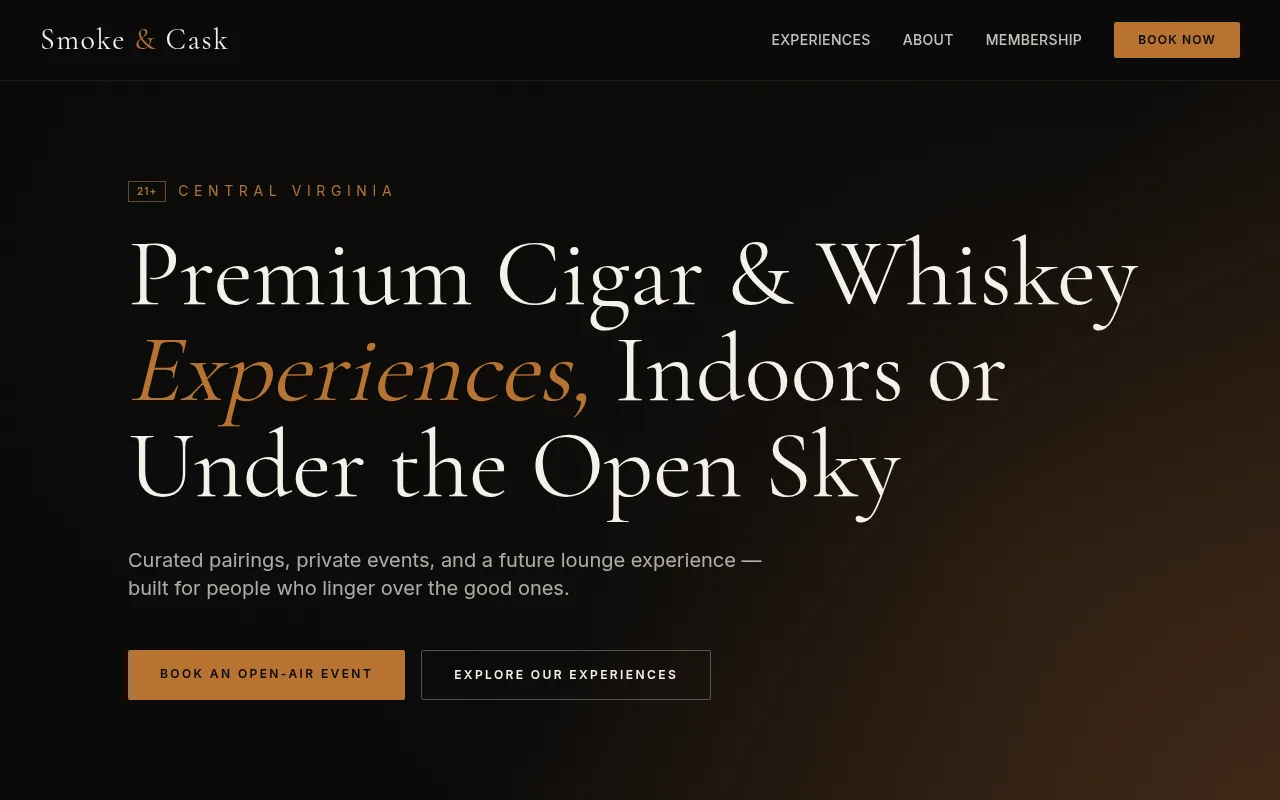
Smoke & Cask hosts cigar and whiskey pairing experiences in Central Virginia. Guests book a private evening at their own venue, and the brand has to feel like the evening: dark surfaces, warm copper, a serif headline face, and photography that does most of the talking. We designed and built the site to carry that.
The booking form asks for the event date, the group size, and a 21+ confirmation along with contact details, and delivers each inquiry by email the moment it is submitted. Because the business touches alcohol and tobacco, the site carries a custom age gate that lets search engines through so every page stays indexable, remembers a verified visitor, and can switch to strict date-of-birth mode later. A mandatory legal line appears on every page of the site, built into the template so it cannot be missed.
That is the shape of most experience sites we build: brand first, one clear booking action, and the legal pieces handled without hurting search. More of our work, including sites for trades and dealers, is on the work page.
We build for other local businesses too
Each industry has its own version of the one thing the website has to do. For an experience business it is the booking inquiry. For a plumber it is the phone call. For a dealer it is the inventory page. See the full list on the industries page, or jump to a related one:
Travel agencies
Another business that sells a feeling and needs the inquiry to arrive with dates and group size attached.
Landscapers
Photo-driven proof, seasonal demand, and quote forms that capture the property details up front.
Plumbers
The other end of the spectrum: plain, fast, and built to make a phone ring the day something breaks.
Event and experience website questions
Let's build the site your experience deserves
Tell us what you host, where, and how people book today. We will come back with a plan for the brand, the booking form, the legal pieces, and the searches you should be showing up for. If you already have a site, start with the free audit and we will tell you what is holding it back.